On this page
Halal Watch World Investigation
Beyond the Potato: We Lab-Tested French Fries From 10 Fast-Food Giants. Half Failed. Only One Passed.
An investigative assessment of halal risks in French fries served by leading U.S. fast-food chains, built on the companies' own ingredient and fryer disclosures, direct inquiries and lateral flow laboratory screening.

French fries feel like the one safe order. Potatoes, oil, salt. What could go wrong?
Quite a lot, it turns out. Over several months, Halal Watch examined the French fries sold by ten of the biggest fast-food chains in the United States: McDonald's, Burger King, Wendy's, Five Guys, Chick-fil-A, Shake Shack, Taco Bell, KFC, Arby's and Popeyes. We read every ingredient statement, allergen guide and frequently asked question we could find, tried to put the same six questions to every company, and had one sample of fries from every chain screened in the laboratory by food scientist Dr. Ahmed Elhag.
The potato was almost never the problem. What sits in the fryer next to it was. Five chains failed our halal review because their own published information shows a beef ingredient or beef flavoring, frying oil shared with non-halal meat, or, in one case, a flat statement that nothing on the menu meets halal standards. Four more leave enough doubt that we advise refraining. Only one earned a pass.
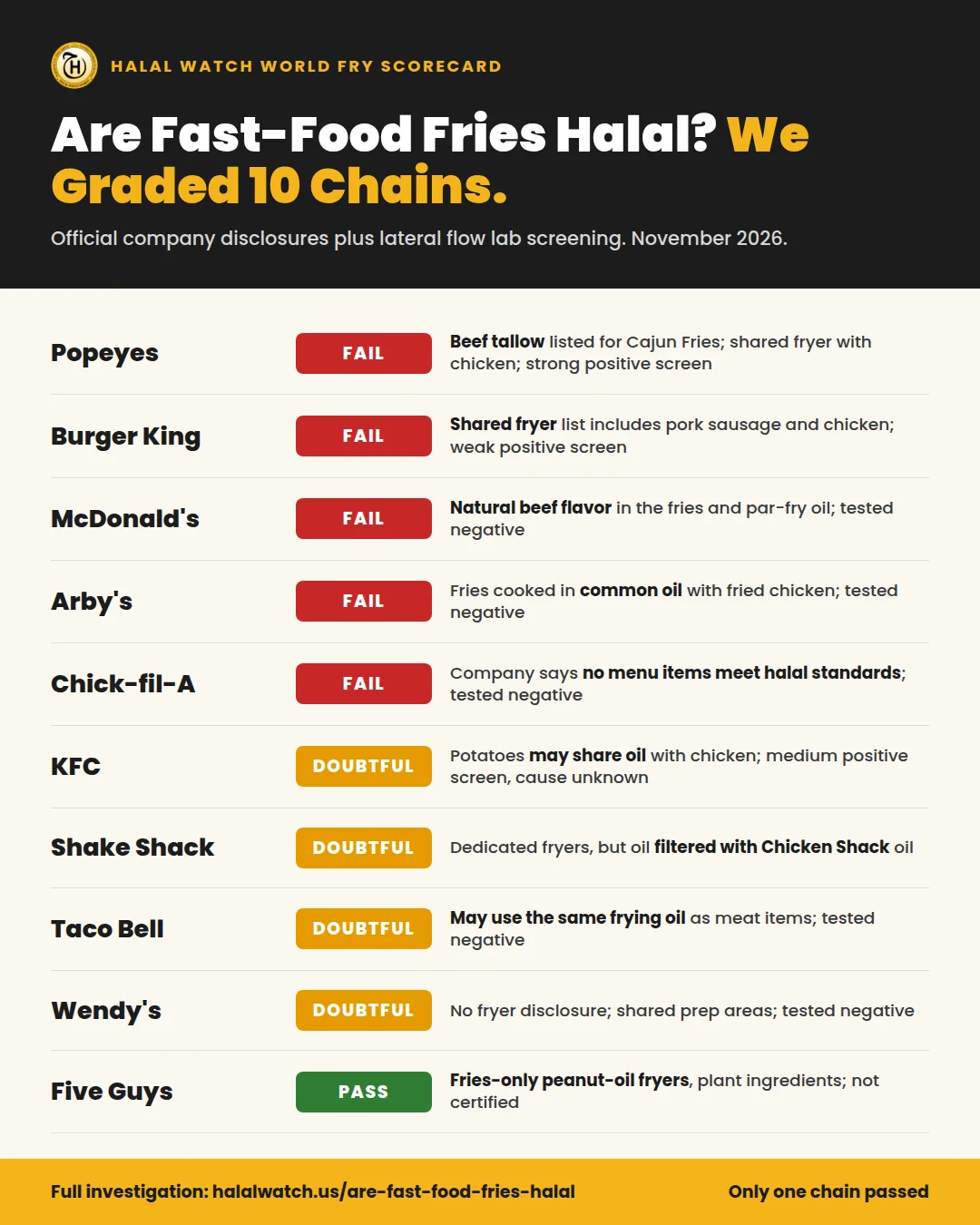
The scorecard: every chain, every grade
Grades follow the Halal Watch standard explained in the next section. Select a chain to jump to its full findings.
Known, doubtful or clear: how we graded
Halal Watch's standard starts from a basic principle of Islamic dietary law: food is presumed permissible unless something known makes it haram. Suspicion alone does not make a food haram. It can, however, make it doubtful, and doubtful food is best left alone.
Laboratory screening is powerful, but it can only find what it is designed to find, and only in the sample in front of it. It cannot read a supplier's flavor formula, and it cannot see what was fried in the same oil an hour earlier. So what is known comes first. When a company tells us in writing that its fries contain a haram ingredient, or share a fryer with chicken that is not halal, that settles the question no matter what a test strip shows. When the information is uncertain, or a test raises a flag the documents cannot explain, the fries are doubtful.
That is the rule Halal Watch applied to every chain in this investigation:
FAIL Known to be not halal
The company's own information, or other credible evidence, shows a haram ingredient, haram frying oil, or fries cooked in a fryer or oil shared with non-halal items, or the company states that its menu items do not meet halal standards. A negative laboratory result does not overturn what is known.
DOUBTFUL Mashbooh: refrain
Nothing known makes the fries haram, but real doubt remains: the company says the fries may share oil or that cross-contact may occur, its fryer practice is undisclosed, or the lab screen was positive without a known cause. A positive screen at a chain whose ingredients, oil and fryers are all known to be clean is treated as a stain on that restaurant's process that requires further investigation. In every doubtful case, our guidance is to refrain.
PASS No known haram, no doubt
The ingredients, the frying oil and dedicated fryers are all disclosed as free of anything haram, nothing in the company's materials raises a doubt, and the lab screen was negative. A pass applies the presumption of permissibility; it is not a halal certification. One chain qualified.
The religious basis
The Qur'an names the categories of food that are prohibited, and the first of them, carrion, is the reason meat from animals not slaughtered according to Islamic law is not halal:
حُرِّمَتْ عَلَيْكُمُ ٱلْمَيْتَةُ وَٱلدَّمُ وَلَحْمُ ٱلْخِنزِيرِ وَمَآ أُهِلَّ لِغَيْرِ ٱللَّهِ بِهِۦ
"Prohibited to you are dead animals, blood, the flesh of swine, and that which has been dedicated to other than Allāh"
Qur'an, Surah Al-Ma'idah 5:3, opening of the verse, Saheeh International translation
Muslims are commanded to eat what is both lawful and wholesome:
يَـٰٓأَيُّهَا ٱلنَّاسُ كُلُوا۟ مِمَّا فِى ٱلْأَرْضِ حَلَـٰلًا طَيِّبًا وَلَا تَتَّبِعُوا۟ خُطُوَٰتِ ٱلشَّيْطَـٰنِ ۚ إِنَّهُۥ لَكُمْ عَدُوٌّ مُّبِينٌ
"O mankind, eat from whatever is on earth [that is] lawful and good and do not follow the footsteps of Satan. Indeed, he is to you a clear enemy."
Qur'an, Surah Al-Baqarah 2:168, Saheeh International translation
And the Prophet Muhammad (peace be upon him) taught how to treat the uncertain cases in between, which is where our Doubtful grade comes from:
الْحَلاَلُ بَيِّنٌ وَالْحَرَامُ بَيِّنٌ، وَبَيْنَهُمَا مُشَبَّهَاتٌ لاَ يَعْلَمُهَا كَثِيرٌ مِنَ النَّاسِ، فَمَنِ اتَّقَى الْمُشَبَّهَاتِ اسْتَبْرَأَ لِدِيِنِهِ وَعِرْضِهِ
"Both legal and illegal things are evident but in between them there are doubtful (suspicious) things and most of the people have no knowledge about them. So whoever saves himself from these suspicious things saves his religion and his honor."
Sahih al-Bukhari 52, narrated by An-Nu'man bin Bashir, opening portion; also reported in Sahih Muslim 1599
The same logic runs through the Halal Integrated Process Standards (HIPS) that Halal Watch World applies in its audits. Under the HIPS fundamentals, a halal product that comes into contact with non-halal material is treated as contaminated, and a kitchen that runs halal and non-halal food through shared, non-segregated equipment sits in the highest-risk category. A fryer is the clearest example of shared equipment there is: the oil touches everything that goes into it.

Inside the lab: what Dr. Elhag tested
To complement the documentary review, Dr. Ahmed Elhag screened one sample of French fries from each chain, coded HW-001 to HW-010, using commercial lateral flow assays (LFAs). An LFA is a rapid antibody test cassette, similar in format to a home test kit: a liquid extract is dropped onto a pad, flows along a strip, and a visible test line appears if the strip's antibodies capture the targeted animal-derived material. A control line confirms the strip worked.

How each sample was prepared
Following the kit's pretreatment procedure, as recorded in Dr. Elhag's laboratory notes:
- All apparatus is cleaned, and disposable droppers are used once, so that contamination cannot interfere with the result.
- A portion of 0.1 g, plus or minus 0.05 g, about the size of a soybean, is cut with scissors.
- The portion is added to the extraction solution and soaked for 10 seconds.
- A swab squeezes the pieces 5 to 6 times and stirs thoroughly, up, down, left and right, for 10 to 20 seconds. This is the solution to be tested.
- Drops of the solution are applied to the test cassette, which is read after it develops.
The screening included positive and negative controls and controlled frying baselines. Because high-temperature frying can alter or break down proteins and weaken antibody-based detection, every result was treated as a screening signal, not as final confirmation.
Watch the full, unedited 7-minute procedure footage
Complete recording of the demonstration: two reference samples taken from cutting and weighing through extraction and application, then the reagent blank.
The results
| Chain | Sample | Screen result | Visual intensity (0 to 2) | Final grade |
|---|---|---|---|---|
| Popeyes | HW-001 | Positive | 2 (strong) | Fail |
| KFC | HW-002 | Positive | 1.5 (medium) | Doubtful |
| Burger King | HW-004 | Positive | about 1 (weak) | Fail |
| Five Guys | HW-003 | Negative | 0 | Pass |
| Taco Bell | HW-005 | Negative | 0 | Doubtful |
| Arby's | HW-006 | Negative | 0 | Fail |
| Wendy's | HW-007 | Negative | 0 | Doubtful |
| Shake Shack | HW-008 | Negative | 0 | Doubtful |
| Chick-fil-A | HW-009 | Negative | 0 | Fail |
| McDonald's | HW-010 | Negative | 0 | Fail |
Three of ten samples, 30 percent, produced a positive screening signal. Popeyes produced the strongest signal, KFC a medium one and Burger King a weak one. At Popeyes and Burger King, the companies' own documents already show the fries sharing a fryer with chicken, and at Burger King with pork sausage too, so the documents and the laboratory bench point the same way. KFC is different: its documents say only that fries may share oil with chicken in some restaurants. A positive screen there, with no known cause, leaves the fries doubtful and calls for further investigation.
What a screen can and cannot tell you
A positive LFA result means the strip responded to the material it targets. On its own it does not establish the source, species, quantity or route of that material, and positive or ambiguous results in heavily processed foods call for confirmatory laboratory testing before they are treated as proof. A negative result does not prove that animal-derived material is absent from a deep-fried food, and it says nothing about flavorings or about what else shares the oil. That is why three chains that screened negative still failed, and why a negative screen alone was never enough to earn a pass.
Chain-by-chain findings
In June 2026 Halal Watch began sending each chain the same six questions about its U.S. operations: which oils are used for fries; whether fries have dedicated oil and fryers or share them with other menu items; what controls limit cross-contact with non-halal meat or animal-based products; whether any halal certification or assurance covers the fries; whether any animal-derived ingredients, flavorings or processing aids are used; and whether fries are pre-treated, coated or seasoned by suppliers. The quotations below come from each company's current U.S. materials, checked on November 9, 2026, unless another date is given.
Popeyes
FAILLab screen: positive (strong), HW-001Why it failed: Popeyes' own U.S. ingredient guide lists beef tallow as a component of its Cajun Fries, and its current allergen guide says the fries are cooked in a shared fryer with its chicken and seafood. Either finding alone would fail the fries. The strongest lab signal in the study came from this sample.
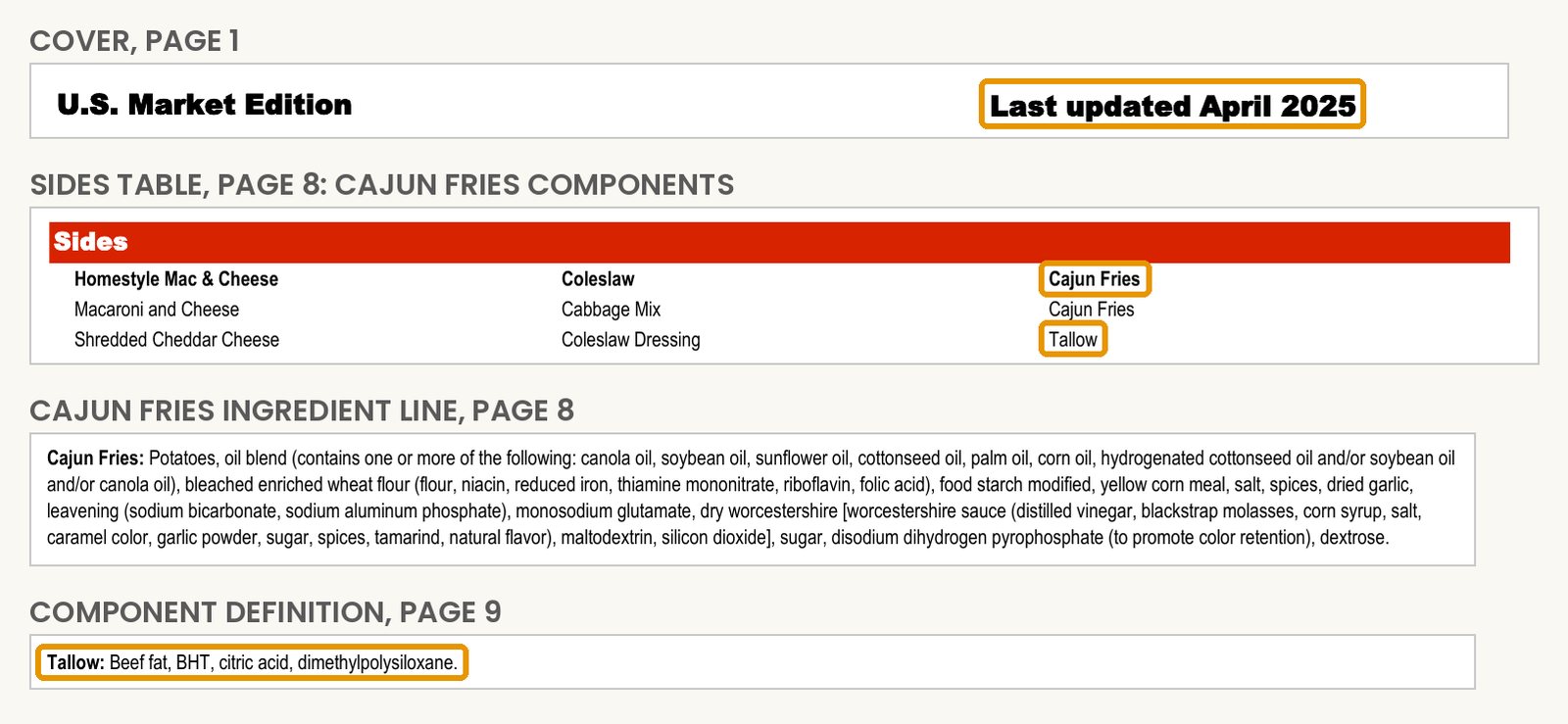
Popeyes' U.S. Market Edition ingredient guide, last updated April 2025, breaks each menu item into components. Under Sides, the Cajun Fries entry has two components: "Cajun Fries" and "Tallow." On the next page the guide defines that component plainly:
"Tallow: Beef fat, BHT, citric acid, dimethylpolysiloxane."
Popeyes U.S. Ingredient Information, last updated April 2025
The guide notes that recipes and ingredients can change before the list is updated. Popeyes' current allergen guide, dated November 2026, adds the fryer picture:
"Products fried in a shared fryer include but may not be limited to: Signature Bone-in Chicken, Tenders, Wings, Chicken Sandwich Filet, Seafood, Cajun Fries, Cajun Onion Rings, and Fried Pies."
Popeyes U.S. Allergen Information, November 2026
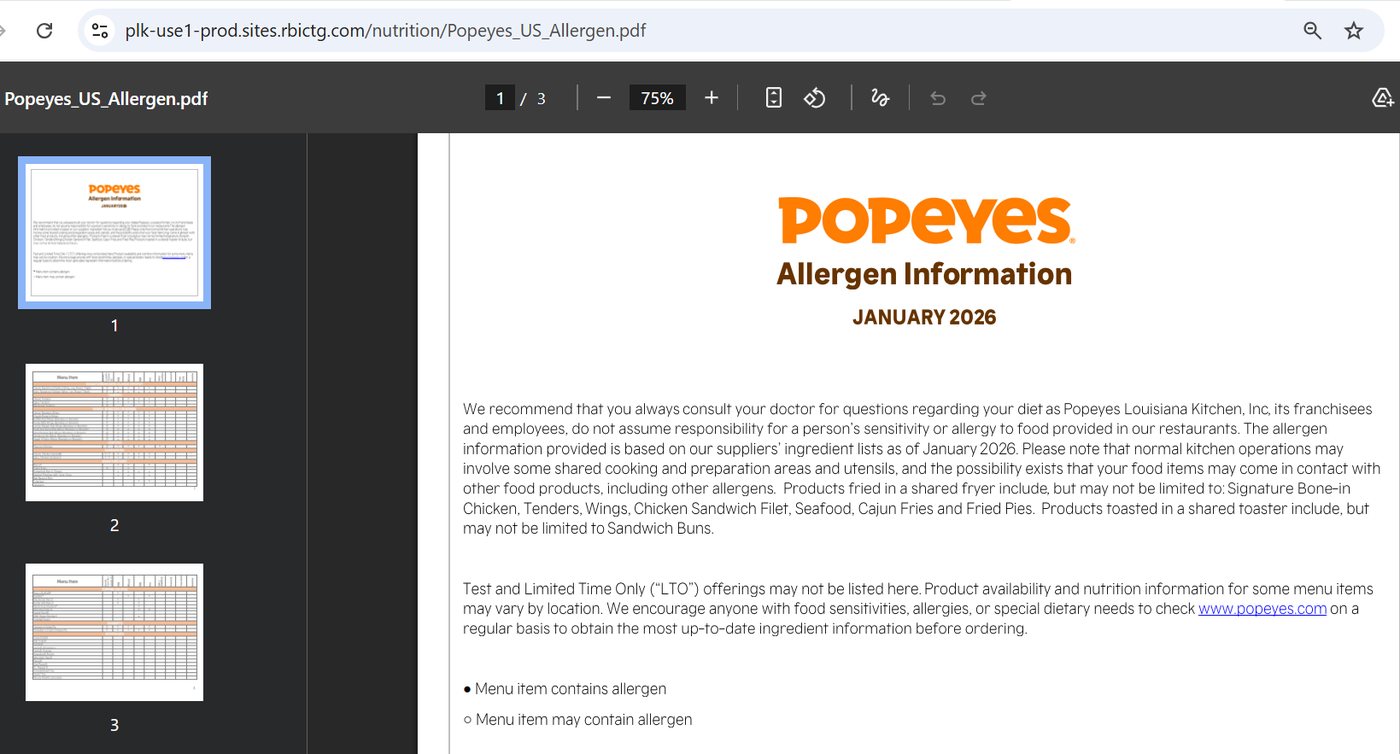
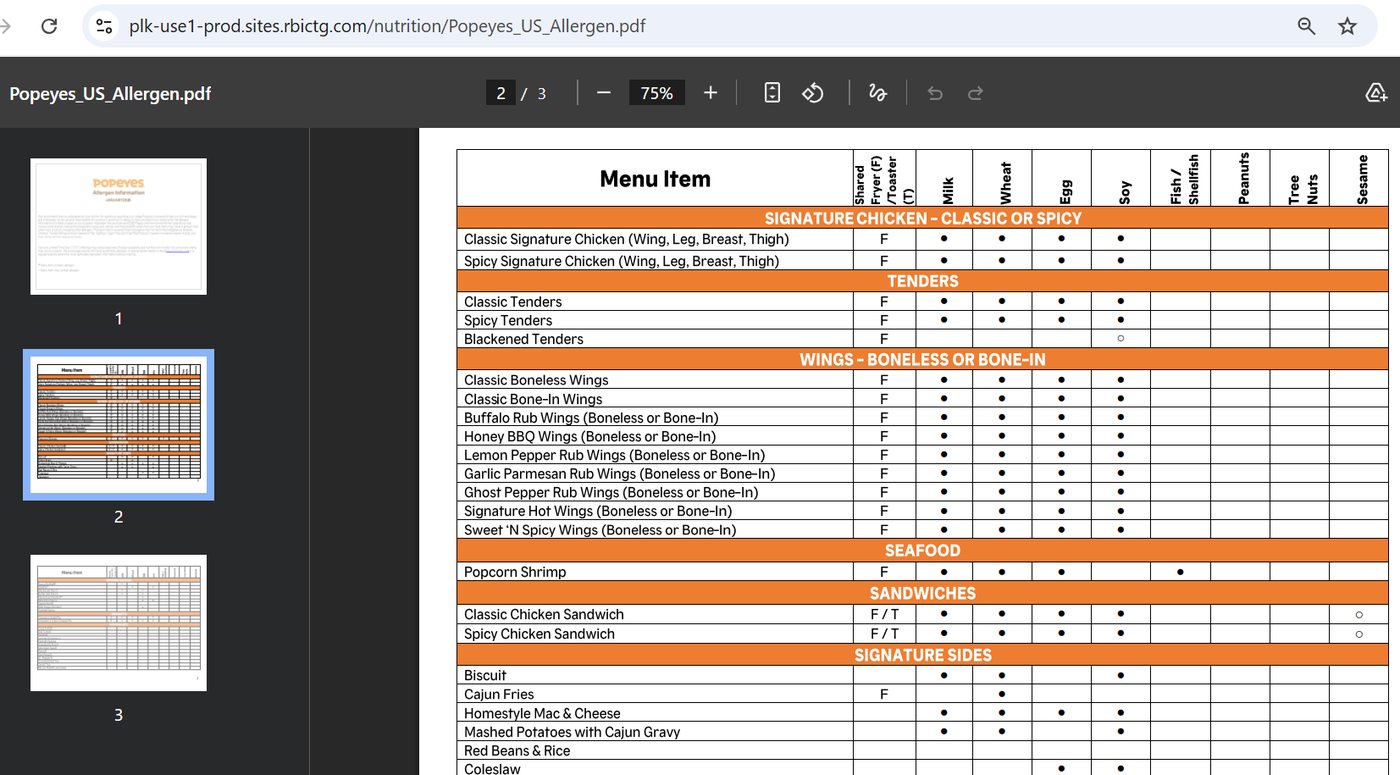
Popeyes allergen guide as captured during the investigation (January 2026 edition). The November 2026 edition repeats the shared-fryer statement and marks Cajun Fries "F" for shared fryer.
Popeyes publishes no halal certification for its U.S. chicken or fries. Halal Watch's inquiry by email received no response. For more on the chicken itself, see our report Is Popeyes chicken halal?
Burger King
FAILLab screen: positive (weak), HW-004Why it failed: Burger King's U.S. allergen guide marks its French Fries as fried in a shared fryer, and its list of shared-fryer products includes pork sausage, fish and several chicken items. The sample produced a weak positive screen.
"Products fried in a shared fryer include, but may not be limited to: Fish Filet, Pork Sausage, Royal Crispy Chicken Filet, Chicken Nuggets, Original Chicken Patty, Chicken Fries, Hash Browns, Mozzarella Fries, French Toast Sticks and Onion Rings. In Hawaii, Portuguese Sausage is also fried in a shared fryer."
Burger King U.S. Allergen Information, June 2025, linked from bk.com/allergens
French Fries are not named in that sentence, but the list is expressly not exhaustive, and the same document's tables mark French Fries with "F" in the shared fryer and toaster column. Burger King's ingredient statement for the fries names only plant-based ingredients, cooked in vegetable oil. The concern is not what goes into the fries; it is what else goes into the fryer.
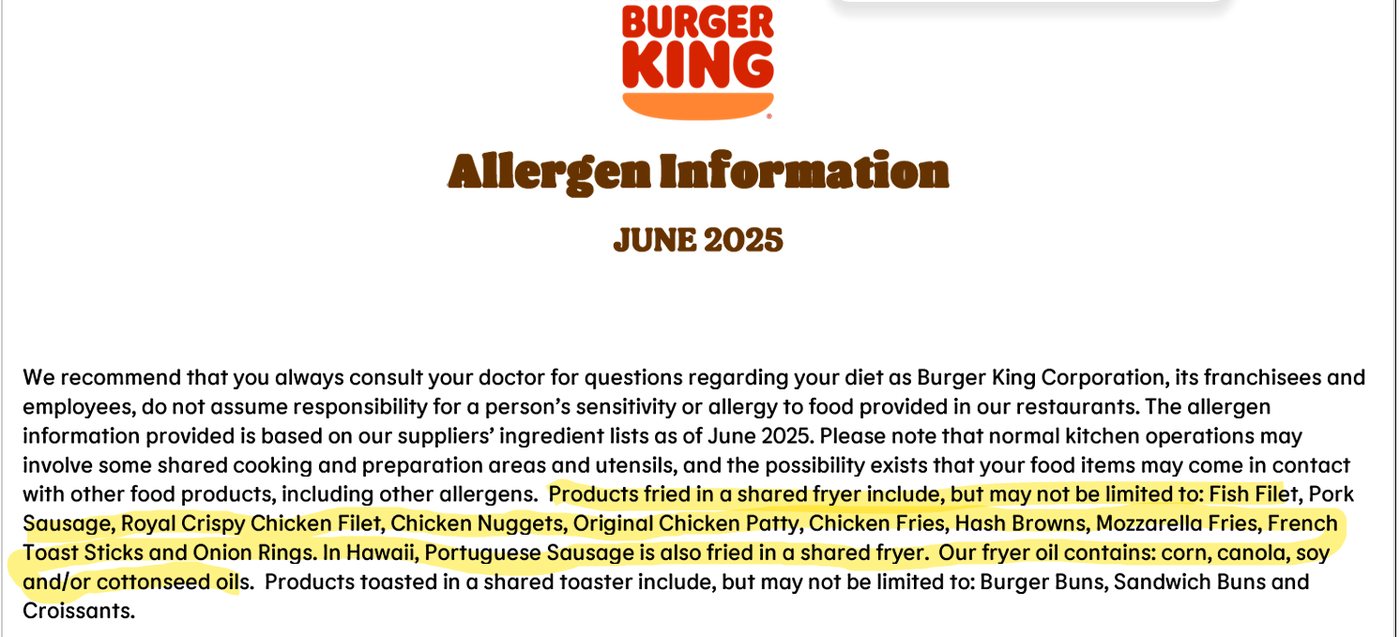
Burger King publishes no halal statement for its U.S. menu. Halal Watch submitted its inquiry through the company's online contact form and received no response.
McDonald's
FAILLab screen: negative, HW-010Why it failed despite a negative test: McDonald's lists "Natural Beef Flavor" in its U.S. fries, and says its suppliers partially fry the potatoes in an oil blend containing beef flavoring. McDonald's does not certify any U.S. menu item as halal. A lateral flow strip is not designed to catch a flavoring, so the negative result does not clear the fries.
"Ingredients: Potatoes, Vegetable Oil (canola Oil, Corn Oil, Soybean Oil, Hydrogenated Soybean Oil, Natural Beef Flavor [wheat And Milk Derivatives]*), Dextrose, Sodium Acid Pyrophosphate (maintain Color), Salt. *natural Beef Flavor Contains Hydrolyzed Wheat And Hydrolyzed Milk As Starting Ingredients."
McDonald's USA, World Famous Fries
A McDonald's FAQ answers the question directly: "Yes. When our suppliers partially fry our cut potatoes, they use an oil blend that contains beef flavoring." The product page also states: "McDonald's USA does not certify or claim any of its US menu items as Halal, Kosher or meeting any other religious requirements."
McDonald's has not said publicly that the flavoring is free of beef, and nothing in its fries supply chain is halal certified. McDonald's itself names the ingredient a beef flavor, in the fries and in the par-fry oil, so Halal Watch treats it as a known disqualifier, not a doubt. The flavoring has a history: in 2002, McDonald's agreed to pay $10 million to vegetarian and religious groups and apologized to settle lawsuits over beef flavoring in its fries, as reported by the Associated Press. We cover the ingredient in depth in Are McDonald's French fries halal?
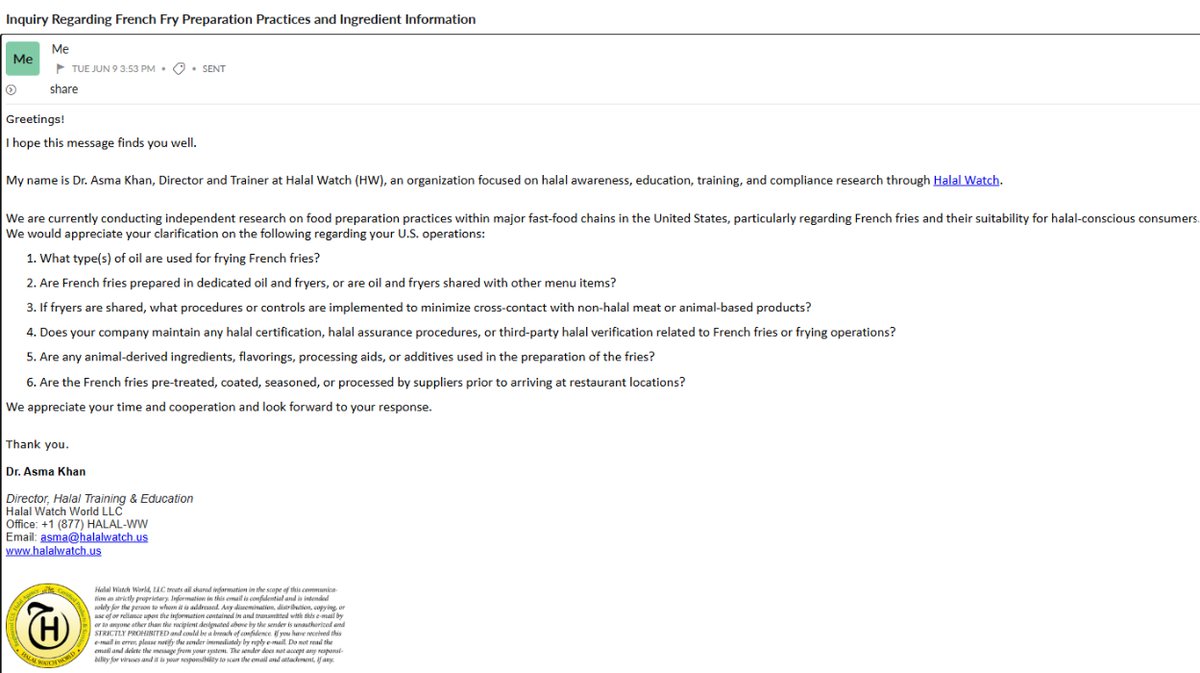
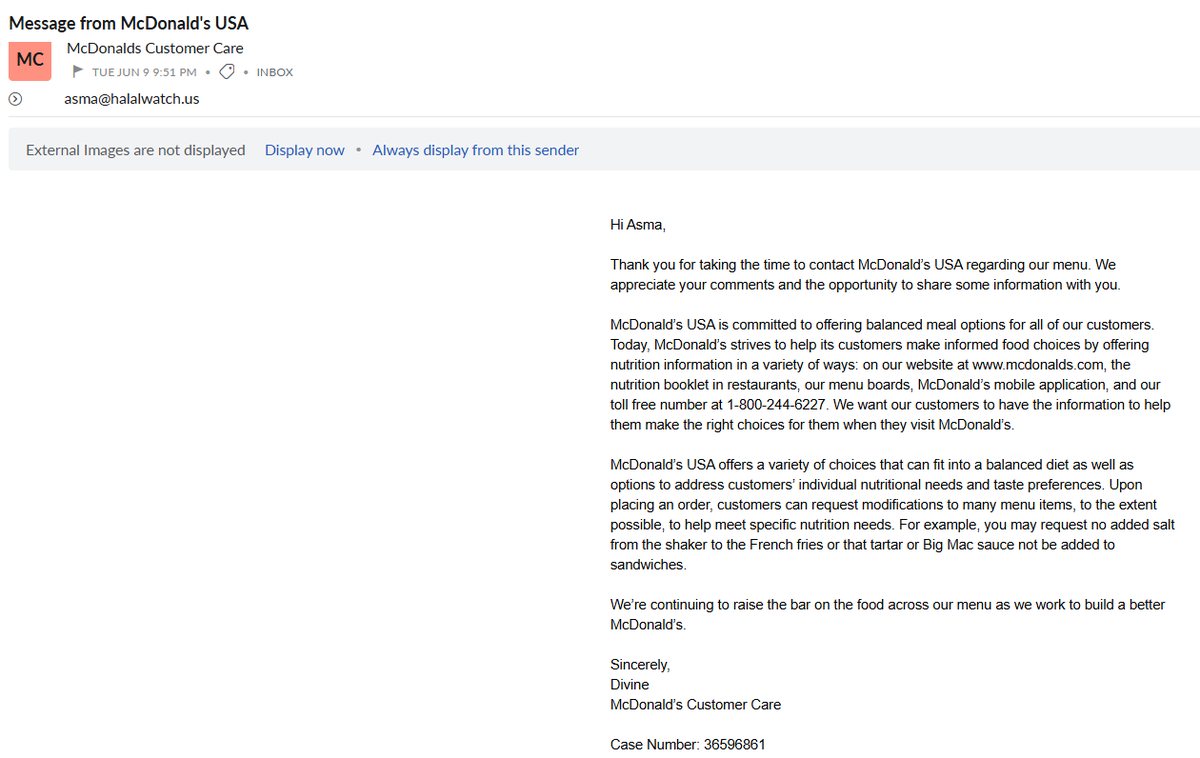
McDonald's was one of only two chains to reply. Its Customer Care team acknowledged the inquiry and pointed to its nutrition resources, website and app, noting that customers can ask for fries without added salt. The reply did not answer any of the six questions about fryers, cross-contact, halal assurance or animal-derived processing aids.
Arby's
FAILLab screen: negative, HW-006Why it failed despite a negative test: Arby's nutrition guide says fried menu items are cooked in common oil, and marks both its Curly Fries and Crinkle Fries, along with its fried chicken items, as cooked in the same oil as other items.
"Fried menu items are cooked in common oil, and possible contact with other major allergens is also indicated."
Arby's Nutritional and Allergen Information, effective October 2026
In the current guide, a dagger symbol means "Menu item is cooked in the same oil as other items that contain major allergens." It appears on both fries and on Chicken Tenders, Crispy Chicken, Buffalo Chicken and other chicken items. Arby's publishes no halal claim for its meat. The guide also lists fish, where available, among the fries' possible-contact allergens.
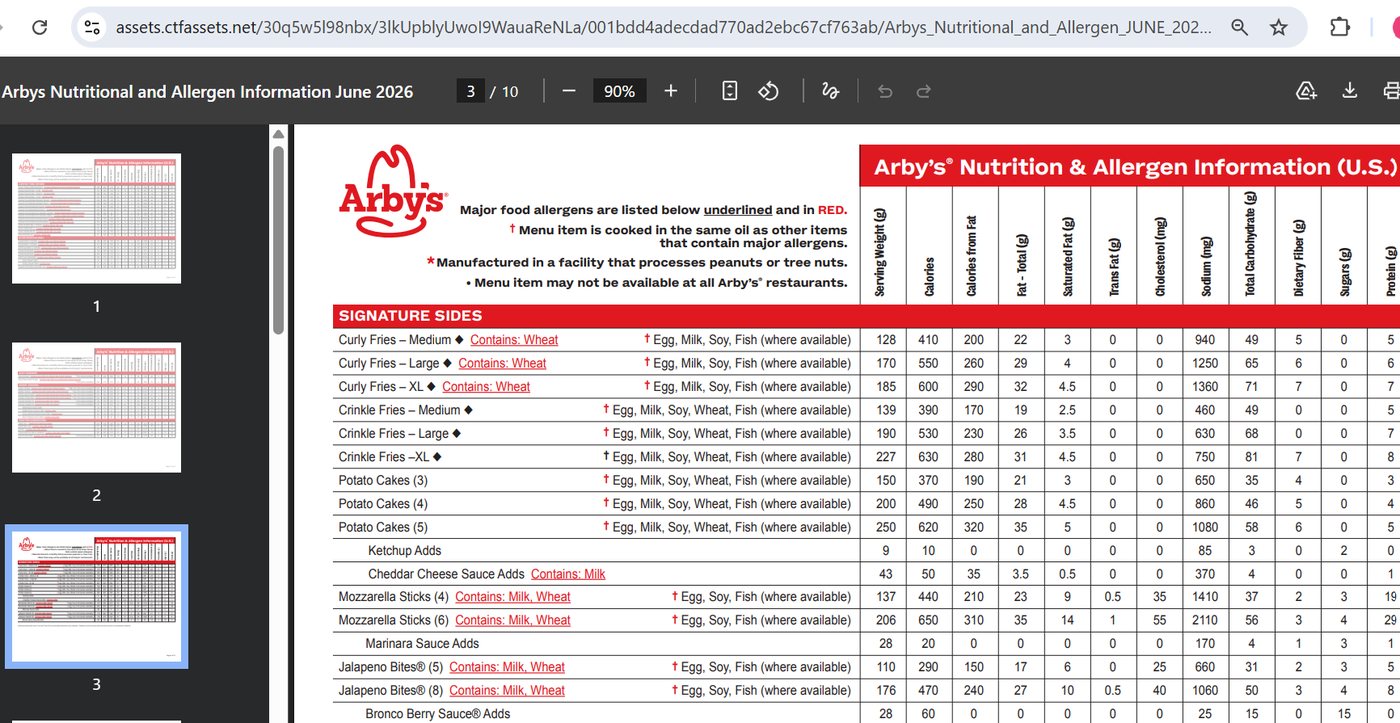
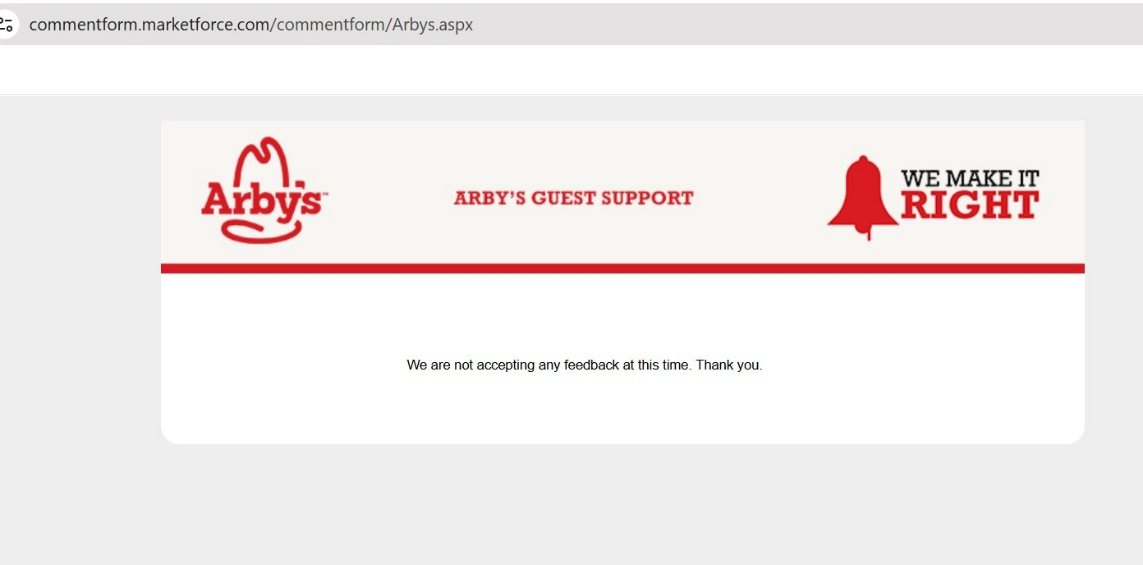
Halal Watch could not put its questions to Arby's at all. The company's guest feedback portal displayed: "We are not accepting any feedback at this time."
Chick-fil-A
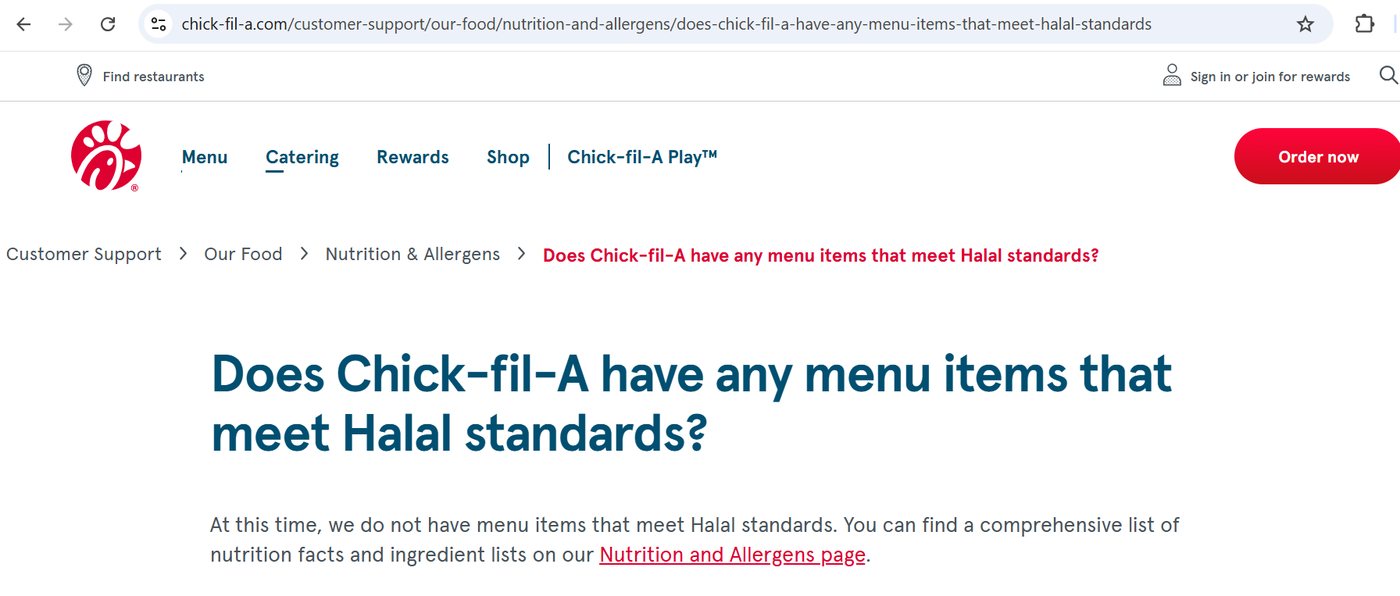
FAILLab screen: negative, HW-009Why it failed despite a negative test: Chick-fil-A states plainly that it does not have menu items that meet halal standards. That is the company's own answer to the halal question, and there is nothing uncertain about it. The Waffle Potato Fries have a plant-based ingredient list, are cooked in canola oil and screened negative, but none of that can override what the company itself says.
"At this time, we do not have menu items that meet Halal standards."
Chick-fil-A customer support
Chick-fil-A describes the fries as "Waffle-cut potatoes cooked in canola oil" and its hand-breaded chicken as cooked "exclusively in fully refined, heat-processed peanut oil." Different oils suggest separate fryers, but that is an inference, not a disclosure. The company also says it uses "shared cooking and preparation areas" and does "not designate vegetarian-only preparation surfaces."
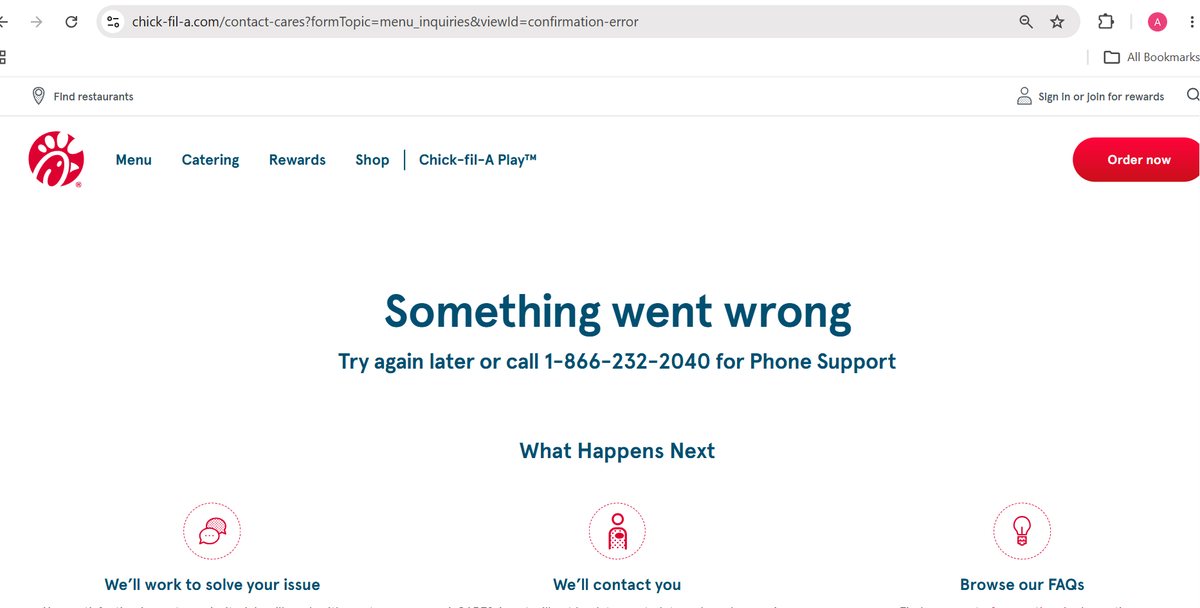
Halal Watch tried to send its questions through Chick-fil-A's customer support form, but the form returned an error and the inquiry could not be submitted.
KFC
DOUBTFULLab screen: positive (medium), HW-002Why it is doubtful, and a red flag: KFC's own nutrition tools say that in some restaurants potatoes may be prepared in the same oil as chicken and fish. That is a possibility, not a known practice at any given restaurant, so the fries do not fail. But the sample produced a medium positive screen that nothing KFC publishes explains. Refrain; the result warrants further investigation.
KFC's U.S. website embeds an official nutrition calculator and allergen tool. The calculator carries this disclosure:
"In some restaurants, fish, chicken, and potatoes may be prepared in the same oil."
KFC Nutrition Calculator, embedded on kfc.com, last updated October 19, 2026
The same tool says: "All vegetarian ingredients are handled by our employees in common with meat ingredients, which may not be acceptable to certain types of vegetarian diets." KFC's allergy page adds that "Our products are prepared on shared equipment and in the same kitchen area and we cannot guarantee that cross contact with allergens will not occur." The Secret Recipe Fries ingredient list includes monosodium glutamate, hydrolyzed soy protein and "natural flavors" whose sources are not identified.
Because KFC states the oil-sharing practice only for "some restaurants," a customer cannot know which kind of kitchen they are standing in. Uncertainty alone does not make the fries haram, but together with a positive lab screen it is more than enough reason to stay away. KFC did not respond to Halal Watch's emailed inquiry.
Shake Shack
DOUBTFULLab screen: negative, HW-008Why it is doubtful despite a negative test: Shake Shack told Halal Watch its fries have dedicated fryers and no animal-derived ingredients. But the oil in its fryers is filtered through the same equipment as the oil for its Chicken Shack, the company says cross-contamination is possible, and its U.S. meat is not halal. A possibility is not a known shared fryer, so the fries do not fail, but the doubt is real. Refrain.
"The oil in our fryers is filtered through the same equipment as our 'Shroom Burgers and Chicken Shack, so while the fries themselves are GF, there's a possibility for cross-contamination."
Shake Shack help center, "What are your gluten-free options?", last updated March 6, 2025
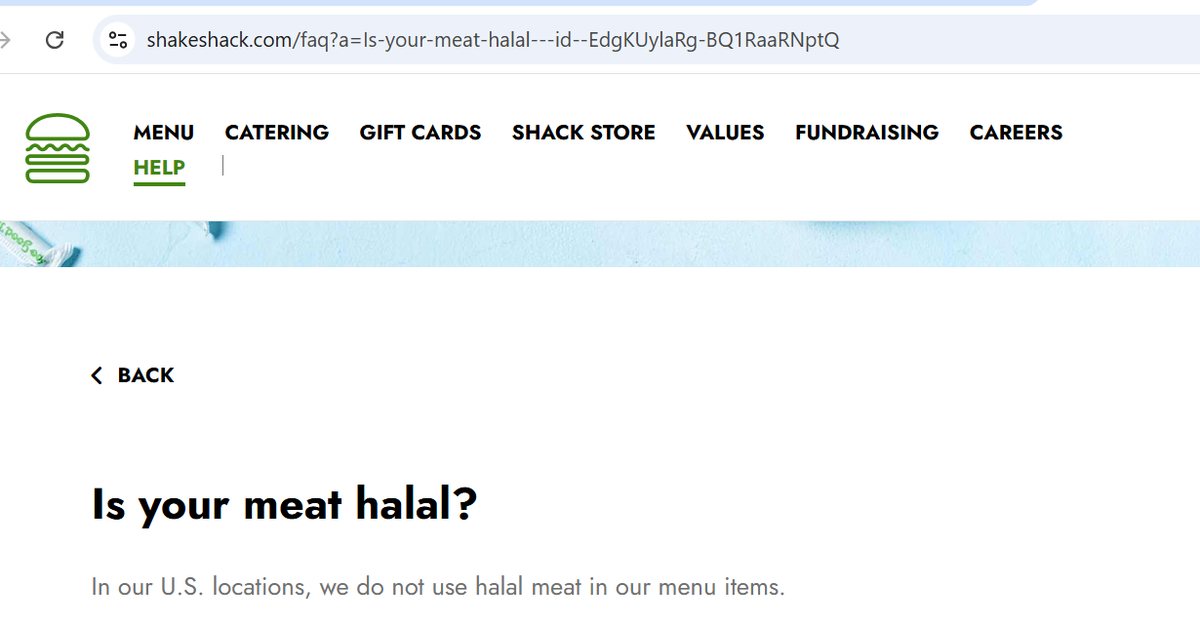
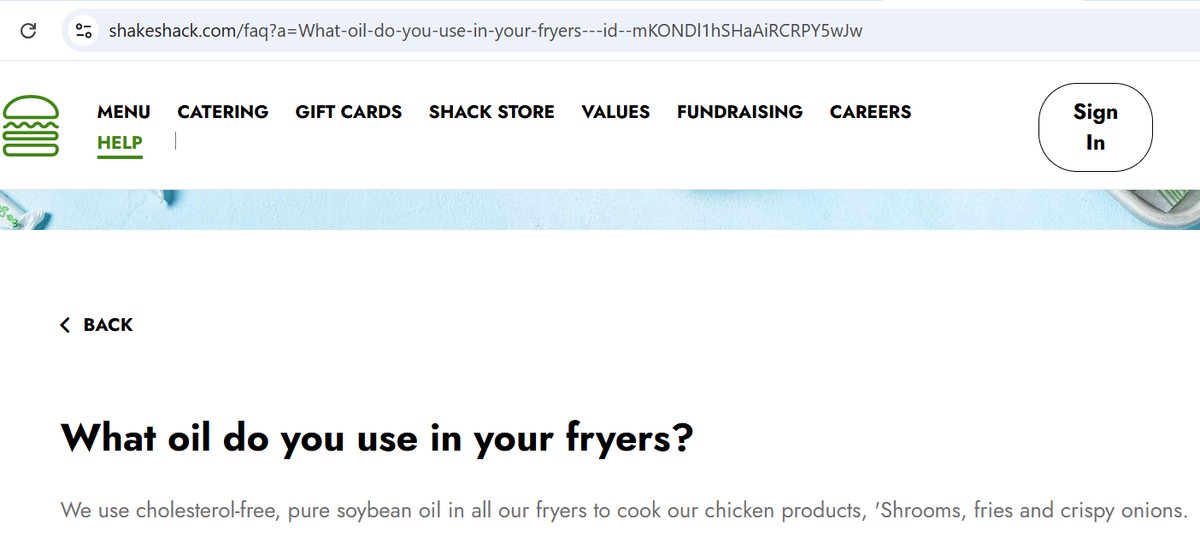
Two other official answers complete the picture. "In our U.S. locations, we do not use halal meat in our menu items." And: "We use cholesterol-free, pure soybean oil in all our fryers to cook our chicken products, 'Shrooms, fries and crispy onions."
Shake Shack gave the most detailed answer of any chain. Its Hospitality Team told Halal Watch that fries are cooked in refined soybean oil in dedicated fryers, "but cross-contact with oil from other fryers might occur during the cleaning process (completed twice daily)." It listed no specific controls, confirmed that its U.S. beef and chicken are not halal, and said the fries contain no animal-derived ingredients and are processed and frozen by a supplier.
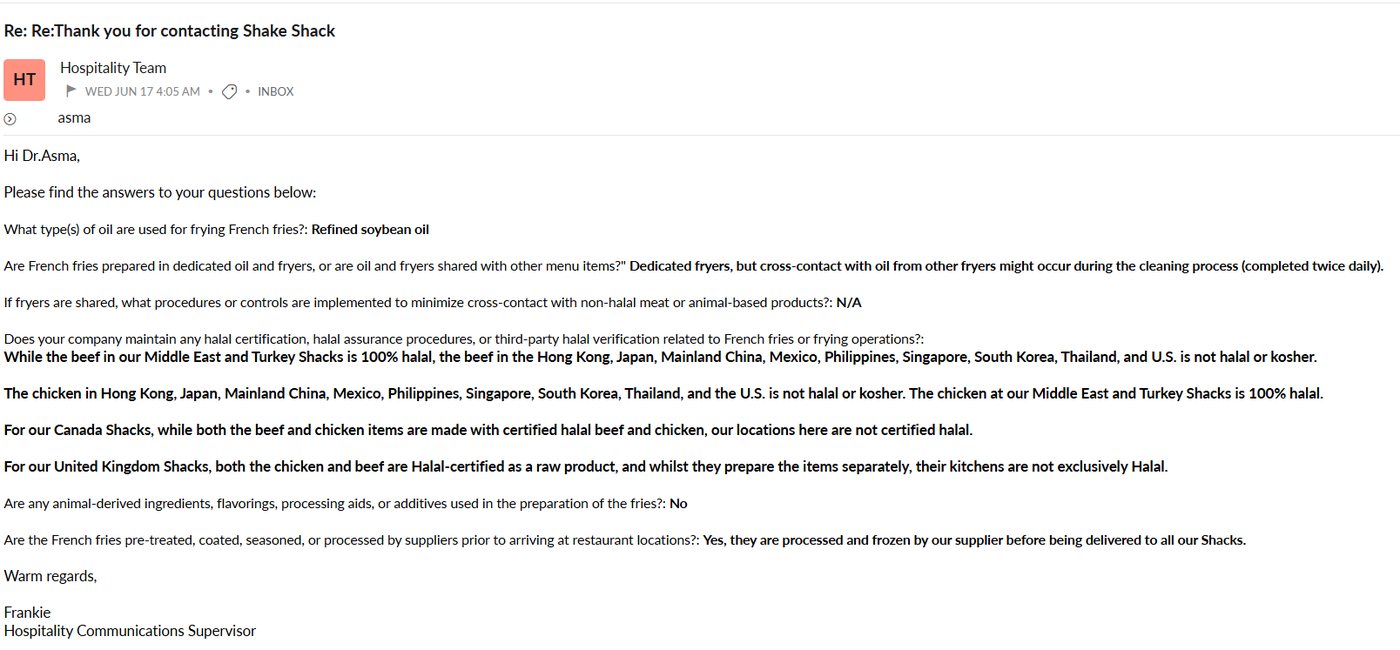
We credit Shake Shack for its candor. Its fryers are dedicated, but their oil passes through the same filtration equipment as the oil used for non-halal chicken, and the company itself will not rule out cross-contact. That is what doubt looks like. One more detail is worth noting: Shake Shack's current nutrition document lists 15 mg of cholesterol for its Regular Fries, even though cholesterol comes from animal sources and the oil is described as cholesterol-free. Shake Shack does not explain the figure.
Taco Bell
DOUBTFULLab screen: negative, HW-005Why it is doubtful despite a negative test: Taco Bell says it may use the same frying oil for menu items that could contain meat, and that in some restaurants it does. That tells a customer the risk exists, not that it applies at the restaurant in front of them. The fries are vegan by ingredient and the sample screened negative, so they do not fail, but the oil question is unanswered. Refrain.
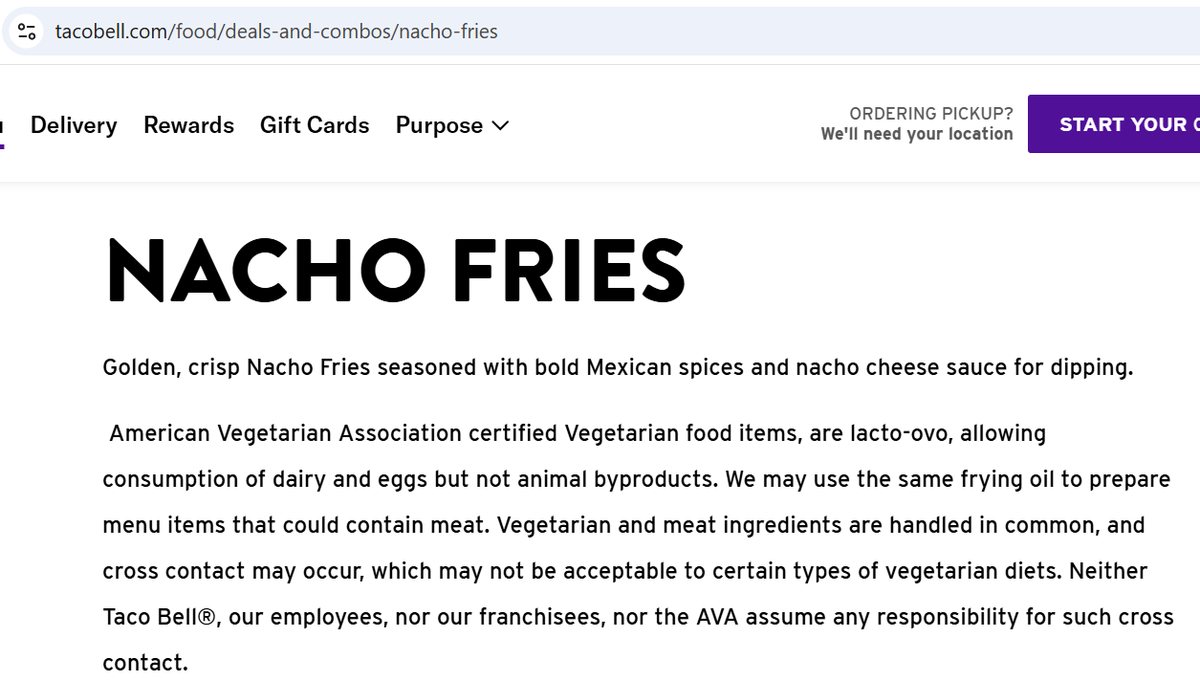
"We may use the same frying oil to prepare menu items that could contain meat. Vegetarian and meat ingredients are handled in common, and cross contact may occur, which may not be acceptable to certain types of vegetarian diets."
Taco Bell, Nacho Fries
Taco Bell's vegetarian guide goes further: "in some restaurants we use the same frying oil to prepare menu items that may or may not contain animal ingredients. Also, we cannot guarantee that cross-contact with meat products will not occur." The seasoned fries themselves are certified vegan by ingredient and prepared in canola oil, and Taco Bell announced in March 2026 that Nacho Fries would join the menu permanently. A vegan ingredient list does not protect fries from the oil they are cooked in.
Halal Watch submitted its inquiry through Taco Bell's inquiry portal and received no response.
Wendy's
DOUBTFULLab screen: negative, HW-007Why it is doubtful: Wendy's lists plant-based ingredients for its fries and the sample screened negative, but Wendy's does not say whether fries share oil with its fried chicken or fish, acknowledges shared handling and preparation areas, and offers no halal assurance. Refrain.
The current ingredient statement lists potatoes, vegetable oil, modified food starch, rice flour, dextrin, salt, leavening and other plant-derived ingredients, cooked in vegetable oil and seasoned with sea salt. No animal-derived ingredient is listed, and the product page carries no fries-specific shared-oil statement. Wendy's general allergen page cautions:
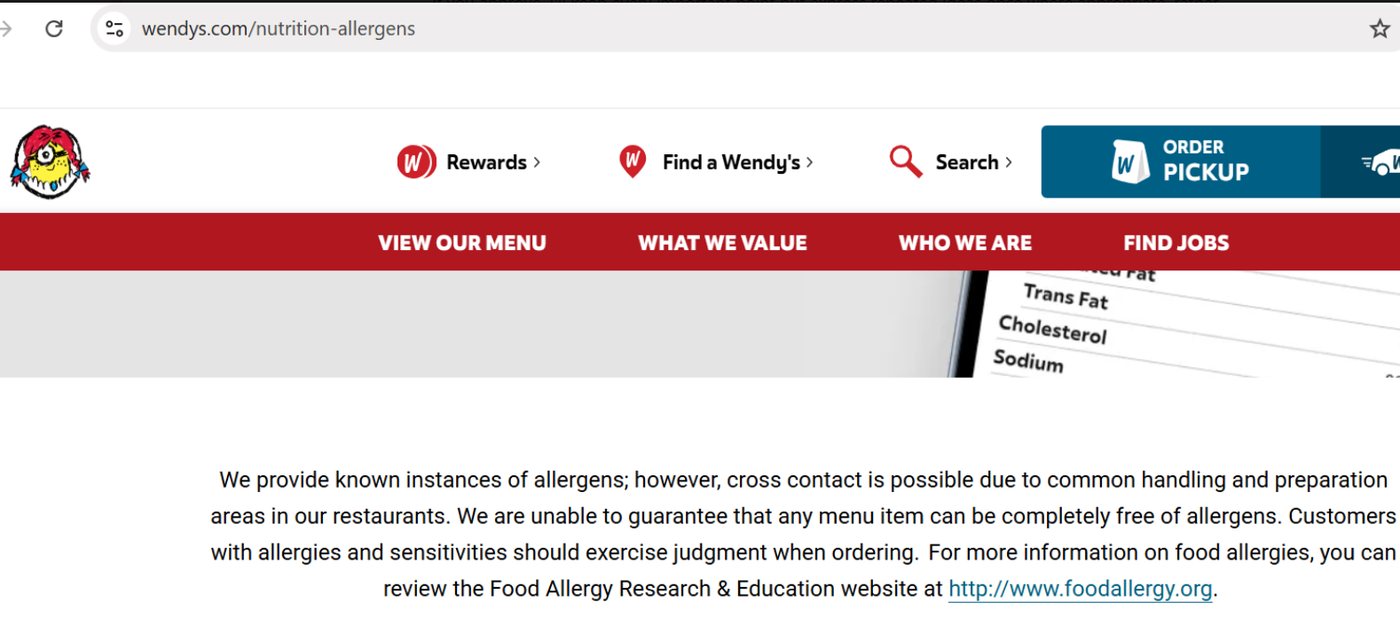
"We provide known instances of allergens; however, cross contact is possible due to common handling and preparation areas in our restaurants. We are unable to guarantee that any menu item can be completely free of allergens."
Wendy's Nutrition and Allergens
An older Wendy's nutrition guide dated January 2011, preserved on a third-party website, marked its fries with a symbol meaning the item "may be cooked in the same oil as an item containing the allergen" for fish, egg, milk and wheat. That document is fifteen years old and Wendy's has since reinvented its fries, so we did not use it as a disqualifier. Wendy's current materials say nothing either way about the fryer, and Wendy's did not respond to the inquiry Halal Watch submitted through its customer support portal.
Five Guys
PASSLab screen: negative, HW-003Why it passed: Five Guys is the only chain that states publicly that its fries are cooked in 100 percent refined peanut oil, in fryers that cook absolutely nothing else, with a plant-based ingredient list. Nothing in its U.S. materials raises a doubt about the fryer, and the sample screened negative. Under the presumption that food is halal unless something known makes it haram, Five Guys fries pass.
"Our potatoes are freshly cut, soaked in water and ONLY fried in refined peanut oil using fryers that cook absolutely nothing else."
Five Guys Nutrition and Allergy Information
Five Guys' U.S. FAQ adds: "Our fries are the only menu item cooked in peanut oil." Its September 2026 U.S. nutrition guide lists the regular fries as "Potatoes, Refined Peanut Oil, Salt," and the Cajun seasoning as plant-based. The FAQ also warns that Five Guys is "unable to ensure no cross-contamination" with peanuts, an allergy warning with no bearing on halal status. And it is direct about the beef: "In the United States and Canada, the beef we serve is not kosher, halal or organic." The pass covers the fries only.
A pass is not a halal certification. These are company statements, not inspections, and Halal Watch could not verify that every location follows them. Five Guys did not respond to the inquiry submitted through its online form.
What this means for Muslim consumers
- Do not assume fries are halal because potatoes are. In this study, the ingredient list was rarely the problem. The fryer was.
- Treat the five failing chains' fries as not halal. Their own published information shows a beef ingredient or beef flavoring, a shared fryer, or no menu items that meet halal standards.
- Refrain from the four doubtful chains' fries. Doubt is not proof of haram, but the Prophetic guidance is to stay clear of it. If you want certainty, ask the manager whether the fries have their own fryer and oil, and whether anything else is ever cooked or filtered with it.
- If you want fast-food fries, Five Guys is the one chain that passed. Its fries are cooked alone in peanut oil, by the company's own account. A pass is not a certification, so it is still worth asking whether your location follows that practice.
- Look for certification, not reassurance. A restaurant that is genuinely halal can show it. Learn what to look for in halal certification for restaurants and in our guide to halal cooking oils.
- Read the labels on frozen fries too. The same questions apply at the grocery store. See Are potatoes always halal? and hidden haram ingredients in food.
Conclusion
French fries are often perceived as one of the simplest items on a fast-food menu. This investigation shows why that perception fails halal-conscious consumers. Across ten of the largest U.S. chains, the potato was almost never the issue. The issues were what is added to it and, above all, what it shares a fryer with.
Applying the Halal Watch standard, five chains fail: Popeyes, Burger King, McDonald's, Arby's and Chick-fil-A. Their fries should not be considered halal. In each case the deciding evidence is the company's own published information: beef tallow listed as a component of Popeyes' Cajun Fries, natural beef flavor in McDonald's fries, frying oil shared with non-halal chicken, pork or fish at Popeyes, Burger King and Arby's, and Chick-fil-A's own statement that none of its menu items meet halal standards. Three of these chains, McDonald's, Arby's and Chick-fil-A, produced negative laboratory screens. Those results do not change the grade, because a negative test cannot outweigh what is known. At Popeyes and Burger King, the positive screens confirmed what the companies' documents already showed.
KFC, Shake Shack, Taco Bell and Wendy's are doubtful. Nothing known makes their fries haram, and Halal Watch does not call food haram on suspicion. But each leaves a real doubt: oil that may be shared, filtration shared with chicken oil, a fryer practice that is never disclosed, and at KFC a positive lab screen with no known cause, which calls for further investigation. Under the Prophetic guidance on doubtful matters, the safer course is to refrain.
One chain passed. Five Guys says its fries are cooked in peanut oil in fryers that cook nothing else, its ingredients are plant-based, and its sample screened negative. That is what the presumption of permissibility rewards: a company that tells its customers enough to remove the doubt. Five Guys is not halal certified, and a pass is not a certification, but it proves that clear disclosure is possible.
The investigation also exposed a transparency gap. Most chains publish allergen charts, but few explain fryer allocation, oil filtration or cross-contact controls, and only two of ten companies answered our questions. Allergen statements were often the only window into the fryer, which is why Halal Watch read them as closely as any ingredient list. Halal assurance requires transparency across the whole chain, from sourcing and processing to frying and consumer communication.
Halal Watch will continue to monitor these chains and will update this report as companies change their practices or answer our questions.
Methodology, scope and right of reply
Chains. Ten nationally recognized U.S. chains were selected for market presence, consumer popularity and the availability of public nutrition and operational information.
Evidence. Official U.S. ingredient statements, nutrition and allergen guides, company FAQ pages and corporate statements; direct inquiries by email, contact form and support portal; and laboratory screening. Every company quotation was rechecked against the live source on November 9, 2026, and document dates are given where the company prints one. Unofficial menu, fan and third-party websites, and non-U.S. company sites, were not used as evidence. Where a company's practice could not be verified, this report says so.
Assessment. Each chain was assessed on ingredient composition, frying medium, preparation environment, corporate transparency and response to Halal Watch's inquiry, then graded under the Fail, Doubtful and Pass standard above. Grades apply the presumption of permissibility: fries fail only on known information, are doubtful where real doubt remains, and pass where neither applies.
Laboratory screening. One fries sample per chain was screened with commercial lateral flow assays, with positive and negative controls and controlled frying baselines, as a supplementary line of evidence. Results are screening signals, not species confirmation.
Scope. Grades are Halal Watch World's consumer assessment of each chain's U.S. fries based on the evidence described. They are not certification audits; none of these companies has applied to Halal Watch World for certification. Practices can vary by location and change over time.
Right of reply. Each company named may send corrections, documentation or updated practices to Halal Watch. Verified information will be reflected in an update to this report.
Frequently asked questions
Are McDonald's fries halal in the U.S.?
No. McDonald's U.S. fries list "Natural Beef Flavor," McDonald's says its suppliers par-fry the potatoes in oil containing beef flavoring, and McDonald's does not certify any U.S. menu item as halal. They failed our review.
Are Popeyes Cajun Fries halal?
No. Popeyes' U.S. ingredient guide lists tallow, defined as beef fat, as a component of its Cajun Fries, and its allergen guide says the fries share a fryer with chicken and seafood. The sample also gave the strongest positive lab screen.
Are Five Guys fries halal?
Five Guys fries passed our review, the only chain to do so. The company says they are fried only in 100 percent refined peanut oil in fryers that cook nothing else, the ingredients are plant-based, and our sample screened negative. They are not halal certified, so the pass reflects the company's disclosures, not a certification.
Are Chick-fil-A fries halal?
No. Chick-fil-A states that it does not have menu items that meet halal standards, so its Waffle Potato Fries failed our review even though the sample screened negative.
Are KFC fries halal?
Doubtful. KFC says potatoes may be prepared in the same oil as chicken and fish in some restaurants, and our sample produced a medium positive screen with no known cause. Halal Watch advises refraining.
Are Taco Bell Nacho Fries halal?
Doubtful. The seasoned fries are vegan by ingredient, but Taco Bell says it may use the same frying oil for menu items that could contain meat. Halal Watch advises refraining.
Which fast-food fries are halal?
Of the ten chains in this study, only Five Guys passed. For assured halal fries anywhere, choose a restaurant with valid halal certification that covers its fryers.
If fries test negative in a lab, are they halal?
Not necessarily. A screening test cannot detect a flavoring or reveal what else was fried in the same oil. Three chains in this study tested negative and still failed because of what their own disclosures show, and four more remain doubtful.
What if fries test positive but the restaurant's practices look clean?
If a restaurant's ingredients, oil and fryers are all known to be clean, a positive screen points to cross-contamination somewhere in that restaurant's process. It does not prove the fries haram, but it is enough doubt to refrain, and it calls for further investigation of that location.
Why does shared frying oil matter?
Frying oil carries material from everything cooked in it. When fries share oil with meat that is not halal, the fries come into contact with that meat, and under Islamic dietary principles and the HIPS standards that contact makes them unacceptable.
Credits
Author: Dr. Asma Khan, Director of Halal Education & Training, Halal Watch World. Dr. Khan designed the assessment framework, conducted the documentary review and company correspondence, and wrote this report.
Laboratory testing: Dr. Ahmed Elhag, Halal Auditor & Food Scientist, Halal Watch World. Dr. Elhag carried out the lateral flow screening and recorded the procedure footage.
Scholarly guidance and editing: Imam Mansoor Rafiq Umar, CEO & President, Halal Watch World.
Cite this report: Khan, A., Elhag, A., & Umar, M. R. (2026). Beyond the Potato: An Investigative Assessment of Halal Risks in French Fries Served by Leading U.S. Fast-Food Chains. Halal Watch World. https://halalwatch.us/are-fast-food-fries-halal
References
Company sources (accessed November 9, 2026)
- Arby's. Nutritional and Allergen Information, effective October 2026. PDF. Menu Items and Ingredients, effective October 2026. PDF.
- Burger King. Allergen Information, June 2025. PDF. Nutrition Explorer. bk.com.
- Chick-fil-A. "Does Chick-fil-A have any menu items that meet Halal standards?" chick-fil-a.com. Waffle Potato Fries. chick-fil-a.com.
- Five Guys. FAQs. fiveguys.com. U.S. Nutrition and Allergen Guide, September 2026. PDF.
- KFC. Nutrition Calculator, last updated October 19, 2026. nutritionix.com. Food Allergies and Sensitivities. kfc.com.
- McDonald's USA. World Famous Fries. mcdonalds.com. "Do you add any type of flavor when preparing your fries?" mcdonalds.com.
- Popeyes. U.S. Ingredient Information, last updated April 2025. PDF. U.S. Allergen Information, November 2026. PDF.
- Shake Shack. Help center answers on gluten-free options, halal meat and fryer oil. shakeshack.com. Nutrition information. PDF.
- Taco Bell. Nacho Fries. tacobell.com. "How to eat veggie at Taco Bell." tacobell.com.
- Wendy's. Nutrition and Allergens. wendys.com. French Fries. wendys.com.
Religious sources
- Qur'an 5:3 and 2:168, Saheeh International translation. quran.com/5/3; quran.com/2/168.
- Sahih al-Bukhari 52. sunnah.com/bukhari:52.
Scientific and regulatory sources
- Choe, E., & Min, D. B. (2007). Chemistry of deep-fat frying oils. Journal of Food Science, 72(5), R77-R86. doi:10.1111/j.1750-3841.2007.00352.x
- Hendrickson, O. D., Zvereva, E. A., Dzantiev, B. B., & Zherdev, A. V. (2021). Sensitive lateral flow immunoassay for the detection of pork additives in raw and cooked meat products. Food Chemistry, 359, 129927. doi:10.1016/j.foodchem.2021.129927
- Raja Nhari, R. M. H., Soh, J. H., Khairil Mokhtar, N. F., Mohammad, N. A., & Mohd Hashim, A. (2023). Halal authentication using lateral flow devices for detection of pork adulteration in meat products: a review. Food Additives & Contaminants: Part A, 40(8), 971-980. doi:10.1080/19440049.2023.2242955
- Regenstein, J. M., Chaudry, M. M., & Regenstein, C. E. (2003). The kosher and halal food laws. Comprehensive Reviews in Food Science and Food Safety, 2(3), 111-127. doi:10.1111/j.1541-4337.2003.tb00018.x
- U.S. Food and Drug Administration. (2022). Food Code. fda.gov/food/fda-food-code
News reporting
- Associated Press via CBS News. (2002, June 5). McDonald's settles beef over fries. cbsnews.com